What Happens Inside Your Body While You Sleep?
You close your eyes. The room goes quiet. Inside your body, the night is anything but uneventful. Follow the changing stages of sleep and discover why a good night is more than a few hours of doing nothing.
Still on the outside. Busy on the inside.
It is easy to think of sleep as the opposite of activity. You stop working, stop moving around and become less aware of the room. But your brain does not simply switch off. Its electrical activity changes, your circulation shifts and your body moves through several distinct states.[1]
That is the first important idea: sleep is a sequence, not one continuous setting. A night contains repeated transitions between non-REM and REM sleep. What happens soon after you fall asleep is not identical to what happens before you wake.
This guide follows that sequence, then turns it into something practical. You can explore an illustrative night, calculate the difference between time in bed and time asleep, and build reminders around your own schedule.
The interactive controls are loading. If this message remains, JavaScript is unavailable or has been removed by the page editor. The article and explanations remain readable.
Step inside a night of sleep.
Set a sleep window, press play and let the night unfold. Tap the timeline to pause at a moment, or compare an early alarm and an interrupted night.
A sleep opportunity, not measured sleep
Settling in
Your sleep window has started. Being in bed is not the same as being asleep.
This is a hand-built teaching sequence, not a prediction from your schedule. It uses an illustrative 15-minute settling-in period. Cycle lengths, stage order and awakenings vary. The early-alarm comparison simply ends the same example two hours sooner. No actual stage durations or health outcomes are calculated.[1]
What actually makes you feel sleepy?
Time awake builds pressure to sleep. Your body clock helps determine when that pressure is easiest to act on.
The longer you remain awake, the greater your homeostatic sleep drive generally becomes. Adenosine is part of the chemistry associated with this pressure. Caffeine can make you feel more alert partly by blocking adenosine receptors, rather than replacing the need for sleep.[2]
Meanwhile, your circadian system organises rhythms across roughly 24 hours. Light is an important timing signal. The clock influences alertness and the timing of melatonin, a hormone associated with the biological night. Sleep pressure and circadian timing interact, which helps explain why being exhausted does not always mean falling asleep is easy.[2]
After a night's sleep, sleep pressure is lower. Daylight helps give the body clock a morning signal.
Conceptual curves for a person waking at 7 am and sleeping around 11 pm. These are not hormone readings or a prediction of your chronotype.
For shift workers and frequent travellers, the clock and the available sleep window may be poorly aligned. A bedtime reminder can organise a routine, but it cannot instantly move the biological clock. This is one reason timing deserves attention alongside duration.[2]
Four stages. Different patterns. One night.
Non-REM sleep contains N1, N2 and N3. REM is a separate state. They recur across the night rather than appearing just once in a fixed staircase. Deep N3 sleep is usually more prominent earlier, while REM episodes tend to lengthen later.[1]
Drifting off
The border between wakefulness and established sleep. It is a relatively light, brief stage, so a sound may easily bring you back.
Settling deeper
You are asleep, but not yet in slow-wave sleep. N2 appears repeatedly and should not be dismissed as filler between more famous stages.
Deep sleep
Brain recordings show prominent slow waves. This stage is harder to wake from and commonly occupies more of the earlier night.
A different state
Rapid eye movements accompany active brain patterns. Most skeletal muscles normally have markedly reduced tone. Dreaming is common, but not exclusive to REM.
Stage descriptions are simplified. The waves are decorative teaching drawings, not diagnostic EEG recordings.[1][11]
REM is not the only useful sleep, and deep sleep is not the only sleep worth keeping. A complete night includes transitions and a changing mixture. A watch's largest or smallest number is not automatically the most important one.
Sleep helps turn experience into memory.
Learning does not end when the lesson, conversation or practice session stops. Sleep before learning helps prepare the brain to take in information; sleep afterwards helps stabilise what was learned. Different forms of memory can involve different aspects of sleep, so there is no single stage that neatly handles every kind of learning.[12]
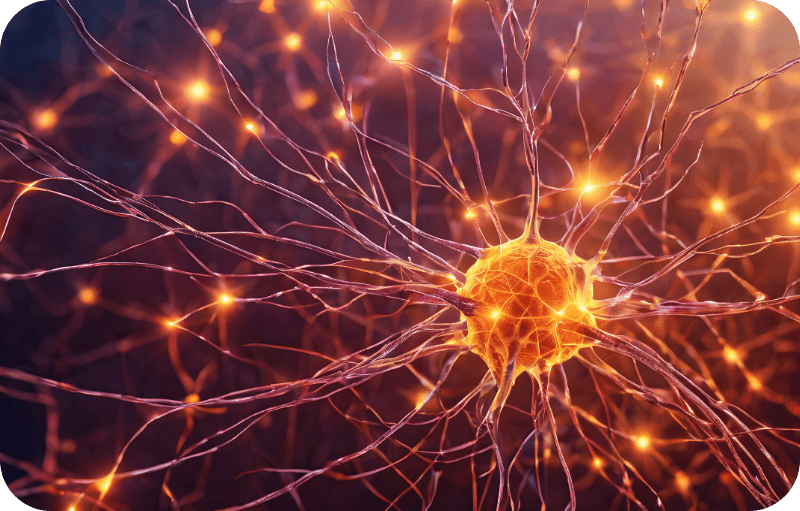
Think of a new route you have driven or a skill you have practised. The experience leaves changes in neural networks. During sleep, those networks can reactivate and reorganise. The illustration below uses connections brightening together to represent this idea. There are no literal files travelling across the sleeping brain.[12]
Press play to follow a remembered pattern through this illustrative network. It is a visual analogy for coordinated activity, not a map of an actual memory.
Ready to explore
A tired brain is not simply a slower version of a rested one.
Insufficient sleep can affect attention, learning, decision-making and reaction time. This matters during ordinary tasks, not just exams. You might overlook an instruction, struggle to follow a conversation or make a driving error. Feeling as though you are coping is not a reliable test of unimpaired performance.[10]
The rest of your body changes gear too.
Sleep is accompanied by changes in cardiovascular activity, metabolism and immune regulation. These processes overlap. The body does not allocate one exclusive hour to muscle repair and the next to immunity.[3]
Recovery is more than being motionless.
Sleep participates in the hormonal environment that supports growth and tissue repair. It also influences how effectively you can train and function the next day. That does not make one good night a substitute for exercise or adequate nutrition. It puts sleep alongside them rather than underneath them.[10]
Immune cells and inflammatory signals also follow sleep and circadian patterns. Enough sleep is part of healthy regulation, not a way to keep immunity permanently “boosted”. Explore that distinction in Why Your Immune System Ages Too.[3]
Eight hours in bed is not always eight hours asleep.
The gap is easy to overlook. Your alarm may be eight hours after bedtime, but you may spend part of that window falling asleep or awake during the night. A sleep diary can help you notice these patterns without pretending you know each stage.[5]
Estimate your time asleep
Uses the bedtime and planned wake-up above, not the illustrative lab scenario. Enter your best estimates; this does not measure sleep. Clock calculations do not include dates or daylight-saving changes.
A time estimate, not a score for sleep quality.
For most adults, guidance recommends roughly seven to nine hours of sleep. Individual needs and circumstances vary. More than nine hours can be appropriate during illness or recovery, so the aim is not to force every person into one precise number.[7]
Two people can also report the same duration and feel very different. Sleep at the wrong time, frequent disruption and untreated sleep disorders can matter alongside total hours.[9]
Why does sleep change as you get older?
Sleep architecture changes across life. Older adults often spend less time in deep sleep, awaken more frequently and become sleepy earlier in the evening. That does not mean they stop needing a full night, or that persistent poor sleep should simply be accepted as an unavoidable birthday present.[5]
Individual nights overlap considerably. These traces use invented timings to explain a population-level tendency, not measured percentages or guaranteed changes at a certain age.[1][5]
Pain, medication, nighttime urination, mood and medical conditions can all complicate sleep. Those are reasons to investigate the pattern, not to blame age alone. Treating a contributing problem may be more helpful than trying to chase a higher deep-sleep number.[5]
This is another example of why ageing is a network rather than one fault. Our guide to the 12 Hallmarks of Ageing explains the wider framework. Sleep is not a standalone “hallmark score”, and this page does not convert missed hours into years of biological ageing.
Make room for a better night.
A regular schedule gives sleep a predictable opportunity. Daylight and physical activity support the daily rhythm, while a bedroom that is dark, quiet and comfortably cool reduces avoidable disturbance. Caffeine, nicotine and alcohol can complicate the night in different ways.[4]
| Factor | A practical approach | What not to assume |
|---|---|---|
| Timing | Choose a realistic sleep window and keep it reasonably consistent. | A rigid schedule cannot override all medical, family or shift-work demands. |
| Light | Seek daylight during the day and reduce bright light near bedtime. | Every person needs precisely the same light schedule. |
| Caffeine | Consider how late you use it and how it affects your sleep. | A fixed cutoff guarantees every trace of caffeine has left your body. |
| Bedroom | Aim for quiet, darkness and a comfortable temperature. | An expensive product is required for a suitable sleep environment. |
These are habit suggestions based on sleep guidance, not a treatment programme for insomnia.[4]
Build your evening
Select reminders that would actually be useful. Times follow your planned bedtime and wake-up. They are planning choices, not biological deadlines.
Your choices appear in the summary below. Nothing is sent to a server or added to your calendar.
Alcohol is not a shortcut to restorative sleep.
It may initially make you sleepy, but alcohol can disturb sleep later in the night. Sedation and a well-organised sleep sequence are not interchangeable. Likewise, routinely spending much longer in bed does not necessarily solve persistent insomnia.[6]
Questions people actually ask about sleep.
Is deep sleep the only stage that matters?
No. N3 is important, but a night also contains N1, N2 and REM. The goal is not to remove every other stage in pursuit of a maximum deep-sleep total. Normal sleep architecture includes a changing mixture.[1]
Does every sleep cycle last exactly 90 minutes?
No. Cycle lengths and contents vary between people and across a night. A bedtime calculator based on exact 90-minute blocks cannot guarantee that an alarm will catch you at an ideal biological moment.[1]
Does dreaming prove I was in REM?
No. Dreams are common during REM, but dreaming can also occur during non-REM sleep. Remembering a vivid dream is not a complete record of your night.[11]
How literally should I take my watch's sleep-stage report?
Consumer devices estimate sleep using their available sensors and algorithms. Treat stage labels as estimates rather than a direct brain recording. The American Academy of Sleep Medicine advises that consumer sleep technology should not replace a comprehensive clinical evaluation. The usefulness of a particular device depends on what it has actually been validated to do.[8]
Can I train myself to need very little sleep?
Is melatonin a general solution for poor sleep?
Some sleep problems deserve assessment.
Loud snoring accompanied by pauses in breathing or gasping, frequent daytime sleepiness and waking unrefreshed can be signs of a sleep disorder. Sleep apnoea is one possible explanation, but symptoms need assessment rather than an online diagnosis.[14]
Long-standing difficulty sleeping also deserves more than another list of bedroom tips. Cognitive behavioural therapy for insomnia, or CBT-I, is commonly recommended as a first treatment for persistent insomnia. It is a structured treatment, not simply being told to relax.[6]
What do you remember?
Your overnight summary
This reflects the schedule, time estimates and reminders you selected. It does not include the invented stage timings from the lab.
- Caffeine check-in
- Begin winding down
- Prepare the room
- Daylight after waking, when available
Runs locally in your browser. No account, tracking requests or diagnostic score. Reloading returns the controls to their defaults.
Sleep is not lost time.
The most useful lesson is not that one stage is a miracle or one bedtime is perfect. It is that the night has structure. Sleep pressure, circadian timing, brain activity and body-wide physiology all contribute to an experience that can look deceptively uneventful from the outside.
A practical starting point is to protect enough opportunity, notice what actually happens within it and investigate persistent problems. Those are more meaningful steps than trying to optimise a number that your device or an online calculator cannot measure precisely.
Give the night room to unfold. Then judge it by how you sleep and function, not just by the graph.
Exploring the broader longevity collection? Visit our NMN and NAD+ supplement range. This article does not establish NMN as a treatment for insomnia or a substitute for sleep.
Sources and further reading
Numbered references connect the explanations to their sources. All diagrams and scenario timings in this article are educational illustrations unless explicitly described otherwise.
- NHLBI, NIH. Sleep Phases and Stages.Sleep architecture, N1, N2, N3 and REM.
- NHLBI, NIH. Your Sleep/Wake Cycle.Sleep pressure, circadian timing, light and melatonin.
- NHLBI, NIH. Why Is Sleep Important?Sleep and cardiovascular, metabolic, immune and brain function.
- NHLBI, NIH. Healthy Sleep Habits.Practical habits and environmental considerations.
- National Institute on Aging. Sleep and Older Adults.Sleep changes, symptoms and sleep diaries in later life.
- NHLBI, NIH. Insomnia: Treatment.CBT-I, treatment decisions and limitations of routine advice.
- NHLBI, NIH. How Much Sleep Is Enough?Adult sleep-duration guidance and individual circumstances.
- American Academy of Sleep Medicine. Consumer sleep technology is no substitute for medical evaluation (2018).The role and limits of consumer technology; individual device validation matters.
- NHLBI, NIH. Sleep Deprivation and Deficiency.Amount, timing, quality and daytime functioning.
- NHLBI, NIH. How Sleep Affects Your Health.Attention, learning, recovery and safety.
- NICHD, NIH. What happens during sleep?Changing body states and dreaming during sleep.
- NIH News in Health. Sleep On It (2013).Sleep before and after learning and memory consolidation.
- Miao A, Luo T, Hsieh B et al. Brain clearance is reduced during sleep and anesthesia. Nature Neuroscience 27, 1046 to 1050 (2024).Original mouse tracer study. Method-specific evidence, not a human sleep prescription.
- NHLBI, NIH. Sleep Apnea: Symptoms.Breathing symptoms and daytime sleepiness that merit assessment.
General educational information, not medical advice. The interactions do not measure sleep, diagnose a disorder or predict health outcomes. Consult a qualified healthcare professional about persistent symptoms, treatment decisions or medicine and supplement use.
Back to the beginning ↑