The science of healthy ageing
Why your skin
changes with age.
Why lines linger, skin feels drier, and a familiar routine can start feeling different.
The short version
Replacing surface cells does not rebuild the supporting tissue underneath. Lines, dryness and changes in resilience can therefore develop even while the outer layer renews.
Moisturising helps the surface retain water. Sun protection reduces additional UV exposure. Understanding their different jobs makes everyday care more useful.
A moisturiser can make skin look smoother, while a deeper crease stays exactly where it was. The skin on your hands may look more weathered than the skin usually covered by your sleeve. And a wash that once felt refreshing can start leaving your face tight.
These changes are often bundled together as “ageing skin”, but they involve different parts of the tissue. Water in the outer layer, the fibres supporting it, the cells maintaining those fibres and a lifetime of sun exposure all contribute. That is why one product or one explanation rarely accounts for everything you notice.
Start with something familiar: a line that used to disappear when you stopped smiling.
01 / From movement to a lasting line
Why do some lines
stop disappearing?
When you smile, squint or raise your eyebrows, muscles move the skin into folds. Younger, more flexible skin tends to flatten again when the movement stops. As flexibility changes with age, some folds remain visible at rest. Lines that appear with movement are often called dynamic lines; those visible without the expression are static lines. [10] [11]
The important change is in how the tissue responds to being folded, not simply in how often you have smiled. Collagen helps skin resist pulling forces, while elastic fibres contribute to recoil. Changes to this supporting tissue make a deeper crease a different problem from a surface that temporarily looks rough or finely lined because it is dry. Both can contribute to how the same line looks; appearance alone cannot tell you which matters most. [1]
Two reasons a line can look different
The outer layer
Why moisturiser can
soften a fine line.
The outermost part of the epidermis is made of flattened cells with lipids between them. Its water content affects how supple and smooth the surface feels. [12] A moisturiser helps retain water there, which can make fine lines less noticeable. [1] [9]
That is a real benefit. If your skin looks smoother after moisturising, improved surface hydration is a plausible explanation. It is not evidence that new collagen has already rebuilt the deeper tissue.
The deeper layer
Why a deeper crease
may remain.
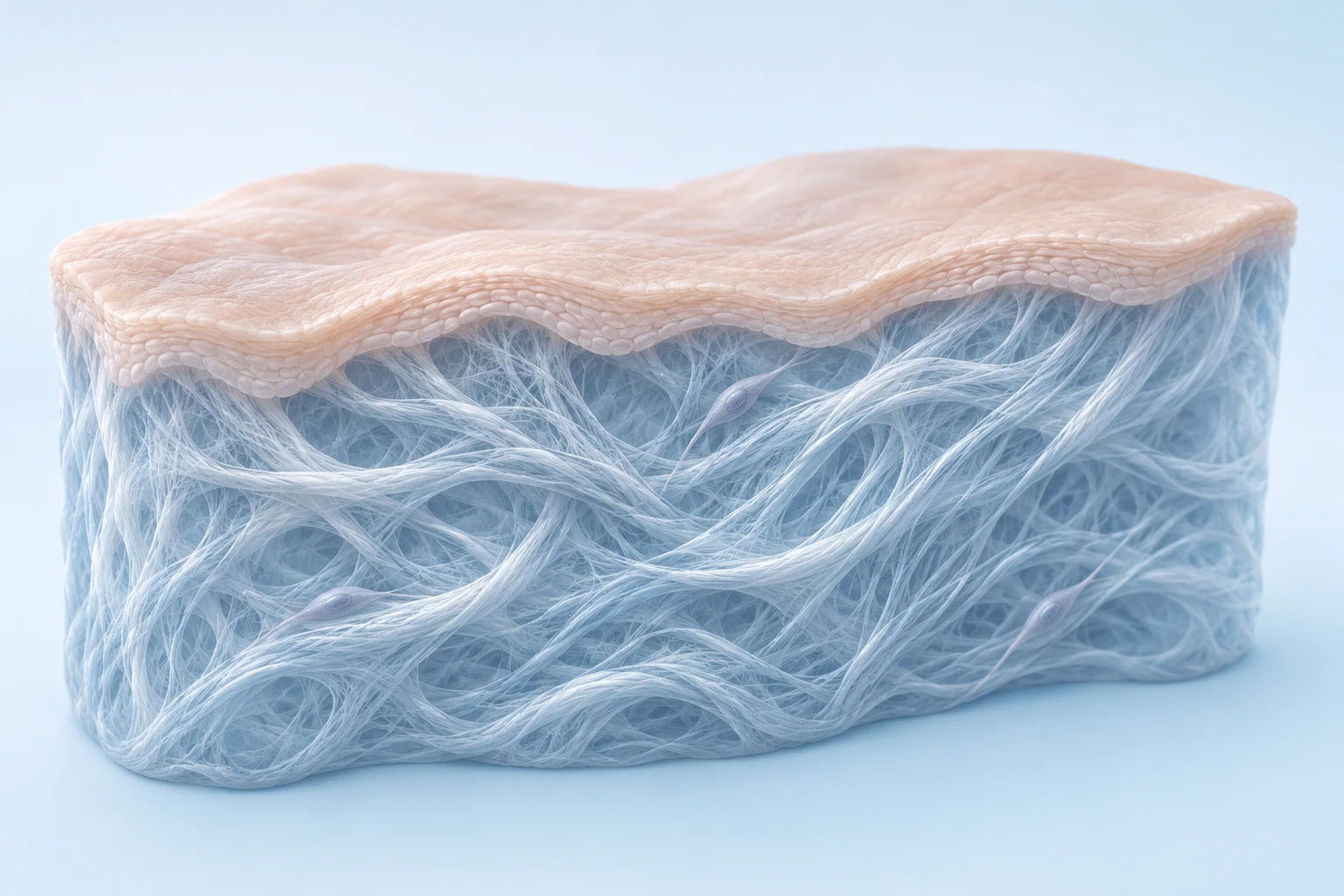
The dermis contains the collagen and elastic-fibre network beneath the surface. When its condition changes, adding water to the outer layer does not by itself rebuild the deeper support network. Deeper folds can therefore remain even when dryness and roughness improve.
Facial contour also depends on underlying fat and other tissues, so laxity is not simply a shortage of surface moisture. For a persistent crease or loss of firmness, a dermatologist can discuss options aimed at that concern. [11]
New surface cells do not
mean a new support network.
The epidermis continually produces cells that mature towards the surface. The dermis is maintained in a different way: cells make and remodel material around them. Shedding and replacing surface cells does not replace the whole collagen network underneath. [1]
Skin can keep renewing its outer layer while deeper structural changes accumulate. To understand why, we need to look at the cells doing that maintenance.
02 / How structural change can reinforce itself
Damage to the fibres
also changes the cells.
Collagen fibres form a supporting network within the dermis. The cells called fibroblasts make and maintain much of the surrounding material, called the extracellular matrix. But a fibroblast is not a free-floating factory: it attaches to the matrix and spreads along it. Those attachments transmit mechanical forces that influence the cell’s behaviour.
Follow the chain
When collagen becomes fragmented, a cell has less effective support to pull against. It can become less spread and experience less mechanical tension. In laboratory models, this altered environment reduces collagen production and can increase activity involved in further matrix breakdown. Damage to the structure can therefore make the work of maintaining it harder. [14] [17]
A comparison of sun-protected skin from adults aged 18–29 and adults aged 80 and over found less collagen production, less cell–matrix contact and less cell spreading in the older samples. That pattern was consistent with reduced mechanical stimulation. The researchers also found age-related differences in fibroblast function, so the surrounding matrix was part of the explanation, not the only cause. [2]
Structure → cell behaviour → maintenance
The support network
helps its own repair cells work.
Attached and spread
Intact surrounding fibres give a fibroblast attachment points and mechanical support.
Less support, altered behaviour
Fragmentation can reduce cell spreading and change the balance of collagen production and breakdown.
03 / Time and exposure leave different patterns
Why does exposed skin
age differently?
Skin usually covered by clothing can develop fine wrinkling with age. Skin with a long history of sun exposure may show more pronounced lines, roughness and uneven pigmentation. Body sites differ naturally, so comparing your forearm with covered skin is not a controlled experiment. It is a useful way to notice that the same number of birthdays does not produce the same result everywhere. [8]
UV exposure adds photoageing to the changes associated with time. It can alter the machinery that maintains the dermal matrix, rather than merely changing the skin’s colour. In controlled human experiments, UV increased matrix-degrading enzymes and collagen degradation. Repeated exposure sustained the enzyme response. [3]
One route from exposure to structural change
More breakdown puts
repair under pressure.
UV changes cellular responses, including enzymes that cut components of the matrix. Repeated exposure adds breakdown to the tissue’s ongoing maintenance work.
Not every mark is a collagen problem
Brown sun spots, or solar lentigines, involve local changes in pigment production and retention after UV exposure. A purple bruise has a different origin: blood has escaped from small vessels. Thinner, more fragile dermal tissue can leave those vessels more vulnerable to minor trauma; some medicines add to that risk. [15] [16]
The distinction matters because a pigment concern, a deeper fold and easy bruising call for different questions. A new or changing mark should not be labelled an “age spot” simply because it appeared later in life.
Use the UV Index, not the temperature
A cool day can still bring substantial UV exposure. Heat is not a measure of how much UV is reaching your skin, and cloud cover is an unreliable guide. Checking the UV Index gives you a more useful basis for deciding when to protect yourself.
In Australia, the threshold for sun protection is a UV Index of 3 or above. That applies to the next exposure even if your skin already has lines or pigment changes. [5]
The UV experiments measured tissue responses, not years of wrinkle formation. Participants had light-to-moderate pigmentation, and different subsets took part in the experiments. [3]
What a moisturiser
is actually doing.
“Moisturising” combines several jobs. Understanding them makes a label more useful than a broad promise of younger skin. A single formulation can combine all three, so this is not a shopping list for three separate products. [13]
Hold water
Humectants
Ingredients such as glycerine attract and retain water in the outer layer.
Smooth the surface
Emollients
These soften roughness by filling spaces and cracks between surface cells.
Reduce evaporation
Occlusives
Ingredients such as petrolatum or dimethicone form a film that reduces water loss.
This is why moisturising while skin is still slightly damp can be helpful: the aim is to retain water, not wait for it to evaporate and then start again. A cream or ointment may suit dry areas better than a light lotion; the right choice also needs to feel comfortable enough to use consistently. [6] [13]
05 / A result in people, over years
Does regular protection
make a visible difference?
There is human trial evidence that consistent sunscreen use can reduce progression on a measured skin-ageing outcome. The recommendation is not based only on knowing that UV can damage collagen.
In Queensland’s Nambour trial, an analysis followed 903 adults under 55 assigned to daily or discretionary sunscreen use. Researchers graded impressions from the backs of their hands over 4.5 years. The daily-use group showed less progression in those skin-ageing grades. [7]
Nambour, Queensland / Randomised trial
Daily use was linked to
less progression.
- Adults in this analysis
- 903
- Follow-up
- 4.5 years
- Outcome assessed
- Hand-skin
ageing grades
Lower relative odds
of progression
Daily vs discretionary sunscreen use
0.7695% CI 0.59–0.98
This is a comparison of progression to higher grades. It does not mean 24% younger skin or 24% fewer wrinkles.
Lower relative odds to the left. Point: estimate. Line: 95% confidence interval.
Use current Australian guidance rather than copying the trial’s historical SPF label. Cancer Council recommends broad-spectrum, water-resistant SPF 50 or 50+, with the other sun-protection measures. [5]
06 / Put the explanation to work
Start with the change
you want to address.
If washing leaves skin tight
Try a shorter wash with warm rather than hot water and a gentle, fragrance-free cleanser. Pat rather than scrub, and moisturise while the skin is still slightly damp. These changes reduce avoidable stripping, friction and evaporation. If dryness, itching or a rash persists, seek advice rather than simply washing harder or adding exfoliation. [6]
If a new “anti-ageing” routine stings
Stinging or burning is not a measure of how much collagen you are making. Adding several products at once can irritate skin and make it harder to identify the cause. Stop a non-prescription product that irritates and reassess; if it was prescribed, ask the prescriber how to respond. A dermatologist can discuss options for a specific concern that basic moisturising does not address. [9]
If you already see sun damage
Keep protecting against the next exposure. When the UV Index is 3 or above, combine clothing, a broad-brimmed hat, shade, sunglasses and broad-spectrum, water-resistant SPF 50 or 50+ sunscreen. Apply as directed and reapply every two hours and after swimming, sweating or towel-drying. Sunscreen supplements these measures; it is not permission to stay outside longer. [5]
Skin can renew at the surface while its support network changes underneath. Moisturising can improve water retention without rebuilding that network; sun protection can reduce new damage without erasing the old. Knowing which job you are doing makes both the biology and the everyday choices much clearer.
For the wider biology, explore the twelve hallmarks of ageing and how DNA maintenance changes with age.
Read the research
Sources & further reading.
- DermNet. The structure of normal skin.Authoritative overview of the epidermis, dermis, skin cells and structural components.
- Varani J, et al. Decreased collagen production in chronologically aged skin. 2006.American Journal of Pathology. Human tissue and cultured-cell research; not a treatment trial.
- Fisher GJ, et al. Pathophysiology of premature skin aging induced by ultraviolet light. 1997.New England Journal of Medicine. Human UV-exposure experiments. Author-university abstract; DOI: 10.1056/NEJM199711133372003.
- Ghadially R, et al. The aged epidermal permeability barrier. 1995.Journal of Clinical Investigation. Human barrier-challenge experiments plus separate mouse studies.
- Cancer Council Australia. UV Index.Current Australian sun-protection guidance, checked 10 November 2026.
- American Academy of Dermatology. How to care for your skin in your 60s and 70s.Gentle care, moisturising and changes that warrant clinical assessment. Australian guidance is used for sunscreen advice.
- Hughes MCB, et al. Sunscreen and prevention of skin aging: a randomized trial. 2013.Annals of Internal Medicine. Nambour trial, 903 adults under 55, 4.5 years. DOI: 10.7326/0003-4819-158-11-201306040-00002.
- DermNet. Skin ageing.Overview of intrinsic ageing, environmental exposure and variation between individuals.
- American Academy of Dermatology. How to maximize results from anti-aging skin care products.Hydration, fine-line appearance, irritation and realistic use of skincare products.
- Mayo Clinic. Wrinkles: symptoms and causes.Facial movement, declining flexibility and persistent folds.
- DermNet. Facial lines and wrinkles.Dynamic and static lines; connective tissue, underlying fat and facial contour.
- DermNet. Dry skin.Water-holding capacity, roughness and environmental contributors to dryness.
- DermNet. Emollients and moisturisers.Humectants, emollients and occlusives: different functions within a formulation.
- Fisher GJ, et al. Collagen fragmentation promotes oxidative stress and elevates matrix metalloproteinase-1 in fibroblasts in aged human skin. 2009.American Journal of Pathology. Human tissue and laboratory models of fragmentation, cell tension and matrix breakdown.
- DermNet. Solar lentigo.UV-associated pigment production and retention; assessment of uncertain lesions.
- DermNet. Senile purpura.Fragile dermal tissue, vessel vulnerability, bruising and medication risk factors.
- Varani J, et al. Inhibition of type I procollagen synthesis by damaged collagen in photoaged skin and by collagenase-degraded collagen in vitro. 2001.American Journal of Pathology. Damaged-matrix experiments support the reduced-production part of the explanation.