
Inside
NMN.
How it supports NAD+
and cellular energy.
NMN helps
your body
make NAD+.
Your cells use NAD+ to help release energy from food. NMN is a building block your body can use to make this essential coenzyme.1
Follow the pathway ↗Your cells use
NAD+ for more
than energy.
Energy production. DNA-damage responses. Sirtuin activity. Different jobs, all involving NAD+.1
See the benefits explained ↗Higher NAD+.
Measured
in humans.
Oral NMN has raised blood NAD+ in clinical trials. Researchers are now testing how that translates into changes in metabolism and physical function.2, 3
Read the human research ↓Scroll to follow the biology.
A long name.
A simple
starting point.
NMN stands for nicotinamide mononucleotide. It is a naturally occurring molecule that sits one enzyme step before NAD+ in a cellular production pathway. NAD+ helps your cells turn nutrients into usable energy and is used by enzymes involved in maintenance.1
That gives NMN a specific purpose: providing a precursor for NAD+ production. Human trials have shown that taking NMN can increase NAD+ measured in blood.2, 5
NMN, NAD+ and ATP each have a part to play. NMN is a building block for NAD+. NAD+ helps transfer energy from nutrients. ATP puts that energy to work inside your cells.1, 8
Follow the energy pathway ↓The pathway
powering your cells.
Food provides the fuel. Your cells need molecular machinery to turn it into usable energy. NMN, NAD+ and ATP play different roles in that process.
NMN is converted into NAD+ within cellular synthesis. NAD+ helps generate ATP through metabolism; it does not simply turn into ATP.1, 8
Tap a molecule to exploreNMN gives your body
a building block for NAD+.
Your cells already make NMN as part of their normal chemistry. An enzyme family called NMNAT converts it into NAD+. This is why NMN is called a precursor: it is a starting material for another molecule.1
Oral NMN supplementation has increased blood NAD+ in human trials. Digestion and gut processing also contribute to how swallowed NMN enters NAD+ metabolism, so its journey involves more than absorption of the intact molecule.2, 5
NAD+ helps turn
food into cellular energy.
As your cells break down nutrients, NAD+ picks up electrons and becomes NADH. In mitochondria, NADH passes electrons into the machinery that helps produce ATP. NAD+ is regenerated so the cycle can run again.8
NAD+ is an electron carrier, not the fuel itself. It moves electrons released from nutrients through energy-producing reactions. Other enzymes consume NAD+ during cellular maintenance, creating a continuing need to replenish it.1
ATP powers
the work your cells do.
Your muscles use ATP to contract. Your cells use it to build proteins, transport substances and maintain the conditions that let nerves send signals. ATP is constantly being used and regenerated to meet that demand.8
NMN helps supply NAD+, and NAD+ helps the reactions that produce ATP. This connects NMN to cellular energy production. It is a metabolic pathway, not a stimulant effect or a guarantee of increased energy.1, 8
Energy.
Repair.
Both need NAD+.
Your cells have two ongoing jobs: produce energy and keep themselves working. NAD+ plays a role in both, linking metabolism with the maintenance systems cells rely on.1
PARP enzymes use NAD+ to help coordinate responses to DNA damage. Sirtuins use it to modify proteins involved in metabolism and stress responses. When these enzymes consume NAD+, the cell has to make more.1
Energy production cycles NAD+.
NAD+ accepts electrons, becomes NADH and is regenerated after transferring them.
Maintenance uses up NAD+.
PARPs and sirtuins consume it. Recycling pathways rebuild the supply.1
Why NAD+
can fall with age.
NAD+ levels reflect what cells make, what they recycle and what they consume. Ageing can shift that balance, but the pattern is not identical in every tissue or person.1
More NAD+ can be consumed.
DNA-damage responses use NAD+. In ageing mice, greater activity of another NAD+-consuming enzyme, CD38, also contributed to falling NAD+ and mitochondrial dysfunction.6
Recycling can become less efficient.
Cells salvage used components to rebuild NAD+. Age-related changes in this production system can reduce replenishment in some tissues, adding to the pressure on supply.1
NMN targets the supply side.
NMN provides a building block for NAD+ production. Human trials have recorded higher blood NAD+ after supplementation, making precursor supply a practical focus of NAD+ research.2, 5
The studies.
Not the slogans.
Human trials have measured higher blood NAD+ after oral NMN. Some have also reported changes in muscle metabolism and physical function. The findings below show the progress so far, together with the limits of each study.
Muscle responded better to insulin.
Participants received 250 mg of NMN daily or placebo. The NMN group showed improved muscle insulin sensitivity: insulin became more effective at stimulating glucose uptake in muscle.
Study context: the trial involved 25 postmenopausal women with prediabetes. The result is specific to that group and does not establish NMN as a treatment for diabetes.
Read the study ↗Blood NAD+ increased in older men.
Daily 250 mg NMN increased whole-blood NAD+ and related metabolites. Some exploratory measures of muscle function improved, but body composition did not significantly change.
Study context: a dispensing error excluded 22 participants' 12-week data, leaving 20 at that time point. Larger studies are needed to confirm the muscle-function findings.
Read the study ↗Higher blood NAD. Longer walking distance.
Over 60 days, adults taking 300, 600 or 900 mg NMN daily showed higher blood NAD measures and greater improvements in a six-minute walking test than placebo. The insulin-resistance measure HOMA-IR did not differ significantly between groups.
Study context: the trial had 20 participants per group and lasted 60 days. The blood measure combined NAD+ and NADH; some authors had manufacturer affiliations.
Read the study ↗NMN raised blood NAD+ in two weeks.
An open-label, randomised study analysed 65 adults across NMN, NR, nicotinamide and placebo groups. The NMN and NR groups, taking 1,000 mg daily, both had higher whole-blood NAD+ after 14 days.
Study context: this was a short-term, open-label study of blood markers. Supporting laboratory experiments suggested that gut processing contributes to how oral precursors work.
Read the study ↗These studies tested NMN ingredients, not our finished NMN Ultra product. Their doses are research protocols, not personalised recommendations. The results support an effect on blood NAD+. Longer studies are needed to establish long-term health and lifespan benefits.
NMN supplies the precursor.
Your body makes NAD+.
Do you need
an NMN stack?
NMN can raise blood NAD+ without a complicated stack. Human trials have observed this effect with NMN taken on its own, without added resveratrol or TMG.2, 5
A stack simply means taking several supplements together. Resveratrol, TMG, quercetin and fisetin are often paired with NMN, but they are different ingredients with different roles. Combining them does not automatically make NMN more effective.
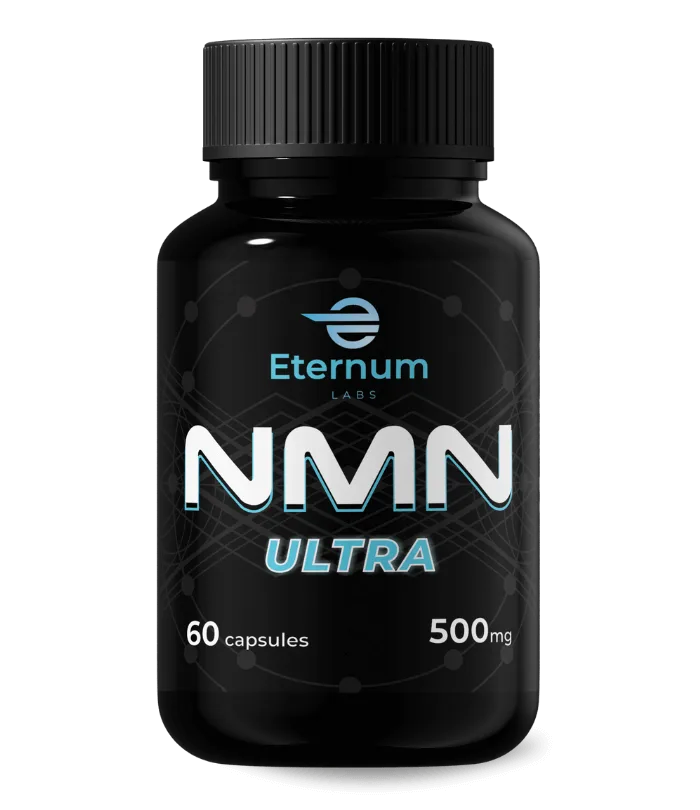
Our NMN Ultra delivers 500 mg of NMN in every capsule. It is a straightforward way to include an NAD+ precursor in your routine, whether you choose NMN on its own or alongside other supplements.7
NMN.
Ultra.
500 mg of NMN. 60 capsules. One focused formula. We created NMN Ultra for people who want high-strength NMN in a convenient capsule. A simple addition to your routine, built around a precursor your body already uses to make NAD+.7
We make our testing available, too. View our third-party certificate of analysis for a closer look at the NMN behind our formula.9
What can NMN
do for you?
NMN helps supply the NAD+ pathway behind cellular energy and maintenance. Human trials have shown higher blood NAD+ after supplementation, with early findings in muscle metabolism too.1, 2, 3
Raise NAD+ levels.
NMN provides a precursor your body uses to make NAD+. Oral supplementation has increased whole-blood NAD+ in human studies, demonstrating a measurable effect on the pathway.2, 5
See the blood NAD+ results ↗Cellular energy production.
NAD+ helps convert energy from food into ATP, the energy your cells use. Muscle contraction, nerve signalling and countless everyday cellular tasks depend on that process.8
Follow the energy pathway ↗Cellular maintenance.
Your cells use NAD+ for more than energy. PARP enzymes draw on it during DNA-damage responses, while sirtuins use it to regulate proteins involved in metabolism and cellular stress.1
Explore the maintenance link ↗Muscle metabolism.
In a small 10-week trial, NMN improved muscle insulin sensitivity in women with prediabetes. This early finding links NMN research with how muscle responds to insulin; broader metabolic benefits still need confirmation.3
Read the metabolism study ↗About the evidence: energy production and cellular maintenance are established roles of NAD+, not confirmed benefits of taking NMN. Human trials have demonstrated higher blood NAD+, but have not established reversal of ageing or longer life.
A few good
questions.
Is NMN the same as NAD+?
No. NMN is a precursor your body can use to make NAD+. NAD+ is the coenzyme used in energy metabolism and cellular maintenance. ATP is the usable energy produced downstream through metabolism.1, 8
Will I notice more energy?
NMN works through NAD+ metabolism, not like caffeine. Human trials have recorded higher blood NAD+, but a noticeable energy boost is not guaranteed. Sleep, nutrition, activity and underlying health also affect how energetic you feel. Persistent or unexplained fatigue deserves a medical assessment.2, 5
How long does NMN take to work?
Blood NAD+ increased after 14 days in one human trial, while other studies assessed supplementation over several weeks. That is a laboratory finding, not a guaranteed date for noticing a benefit. There is no established timeline for how everyone will feel.2, 5
Is NMN better than NR?
NMN and NR are different precursors to NAD+. In a 14-day human comparison, both increased whole-blood NAD+ to a similar extent. Neither precursor has been established as universally better for long-term health outcomes.5, 7
Is more NMN always better?
More is not automatically better. Each NMN Ultra capsule contains 500 mg of NMN. Clinical trials have used a range of doses, but have not established one optimum dose for everyone. Follow the directions supplied with your product and discuss suitability with a healthcare professional.4, 7
What should I know about safety?
NMN was generally well tolerated over the periods studied in the trials featured here. Long-term safety and suitability for every medical situation are not yet established.2, 4 Speak with a healthcare professional before use if you take medication, have a medical condition, are receiving cancer treatment, are pregnant or are breastfeeding.
Do I need resveratrol or TMG with NMN?
Neither resveratrol nor TMG is an established requirement for NMN to raise blood NAD+. The human studies highlighted here include NMN taken without those additions. NMN Ultra can be chosen on its own; any additional supplements should suit your individual needs.2, 5